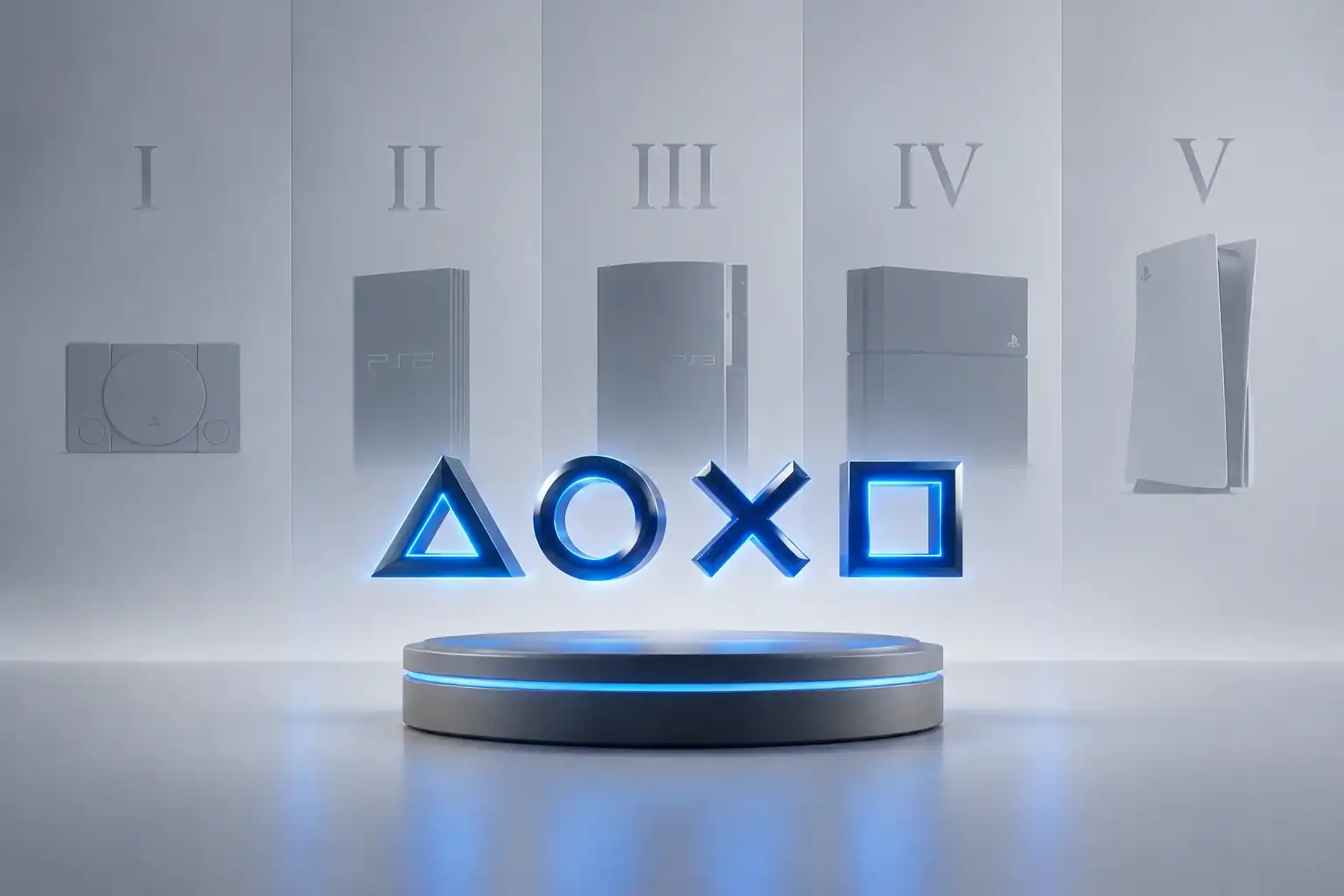
PlayStation has gone through five main home-console generations, beginning with the original PlayStation in 1994 and continuing through PlayStation 2, PlayStation 3, PlayStation 4, and PlayStation 5. Each generation changed more than graphics: PlayStation moved from CD-ROM games and memory cards to DVD and Blu-ray, online services, digital distribution, subscription libraries, SSD storage, and increasingly sophisticated controllers.
The generations also overlap. Sony has released redesigned and more powerful models within individual eras, while handheld systems such as PSP and PlayStation Vita and VR hardware such as PlayStation VR sit alongside the main home-console timeline rather than forming separate numbered PlayStation generations.
This guide explains the PlayStation generations in order, their major release dates, and how PlayStation hardware, controllers, storage, online services, backward compatibility, and game distribution evolved from PS1 to PS5.

When gamers talk about PlayStation generations, they usually mean Sony’s five numbered home-console families:
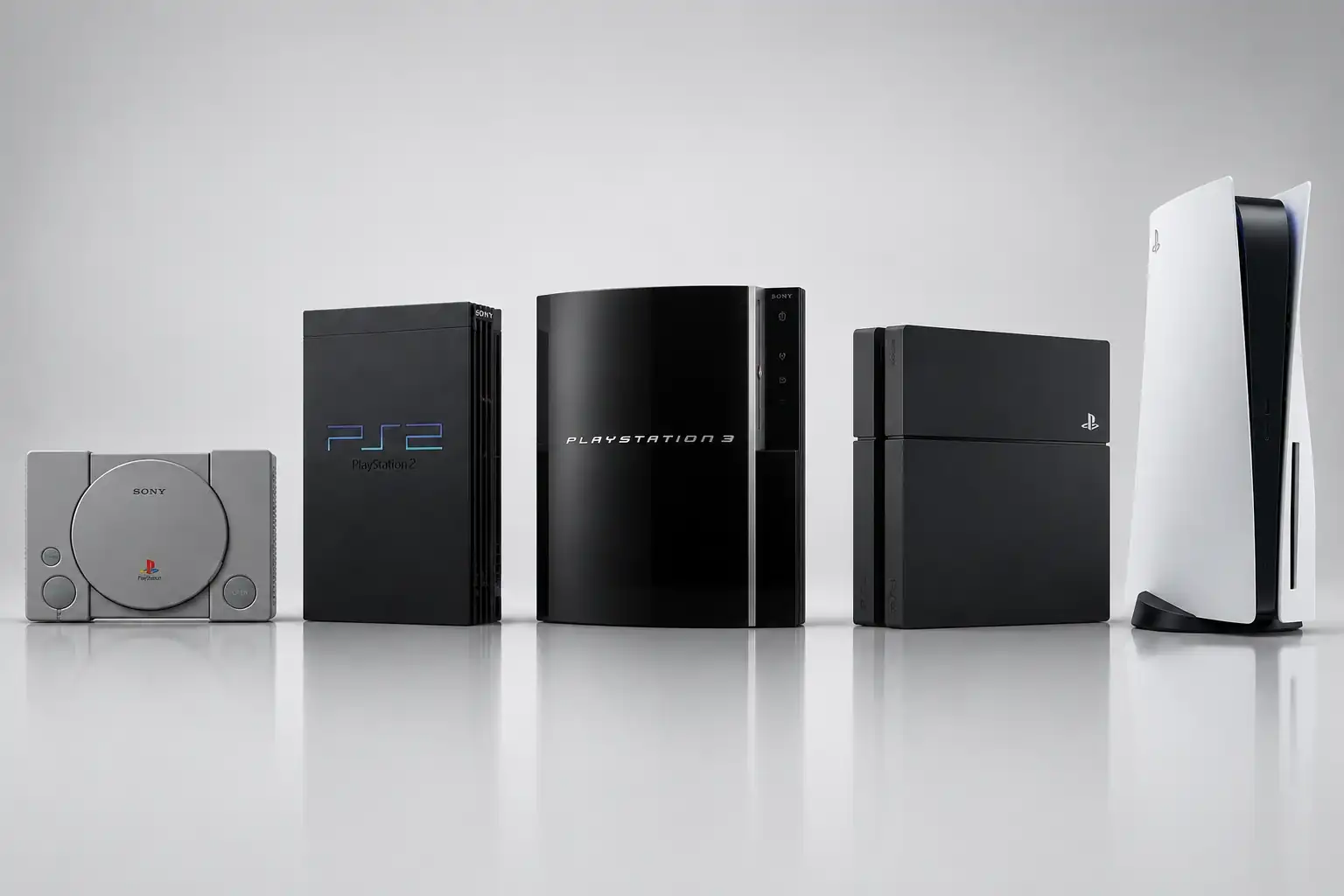
A PlayStation generation is broader than a single hardware model. For example, the PS4 generation includes the original PS4, redesigned PS4 Slim, and higher-performance PS4 Pro.
Similarly, the PS5 generation began with the original PS5 and PS5 Digital Edition in 2020. Sony subsequently introduced the smaller CFI-2000 model group in 2023 and PS5 Pro in 2024.
Systems such as PSP and PS Vita are part of PlayStation history but belong to Sony’s handheld branch rather than the PS1-to-PS5 home-console sequence.
The PlayStation timeline stretches across more than three decades, and release dates differ by region.
| Generation | Console | First release | Major change |
| 1 | PlayStation / PS1 | 1994 | CD-based games and a major push into 3D console gaming |
| 2 | PlayStation 2 / PS2 | 2000 | DVD, larger games, backward compatibility and expanding online play |
| 3 | PlayStation 3 / PS3 | 2006 | Blu-ray, PlayStation Network, PlayStation Store and HD-era gaming |
| 4 | PlayStation 4 / PS4 | 2013 | Greater emphasis on connected, social and digital gaming |
| 5 | PlayStation 5 / PS5 | 2020 | High-speed SSD, ray tracing, DualSense and stronger PS4 compatibility |
The original PlayStation launched in Japan on December 3, 1994, followed by North America and Europe in September 1995. PS2 launched first in Japan on March 4, 2000. PS3 followed in Japan on November 11, 2006, while PS4 first arrived in North America on November 15, 2013. PS5 began its launch on November 12, 2020.
These dates also show why a PlayStation generation cannot be reduced to one worldwide launch date: Sony has historically staggered hardware releases across different regions.
The first PlayStation established the foundation of Sony’s console business.
It launched in Japan in December 1994 and reached North America and Europe in September 1995. Sony says the original PlayStation ultimately sold more than 102 million consoles worldwide.
Technically, one of its defining features was the use of CD-ROM rather than cartridges. The increased capacity of optical media supported larger quantities of audio, video, and game data, while the hardware arrived as developers were making increasingly ambitious moves into real-time 3D environments.
Sony itself describes the original PlayStation era as a transition in which traditional 2D experiences increasingly gave way to more complex real-time 3D worlds.
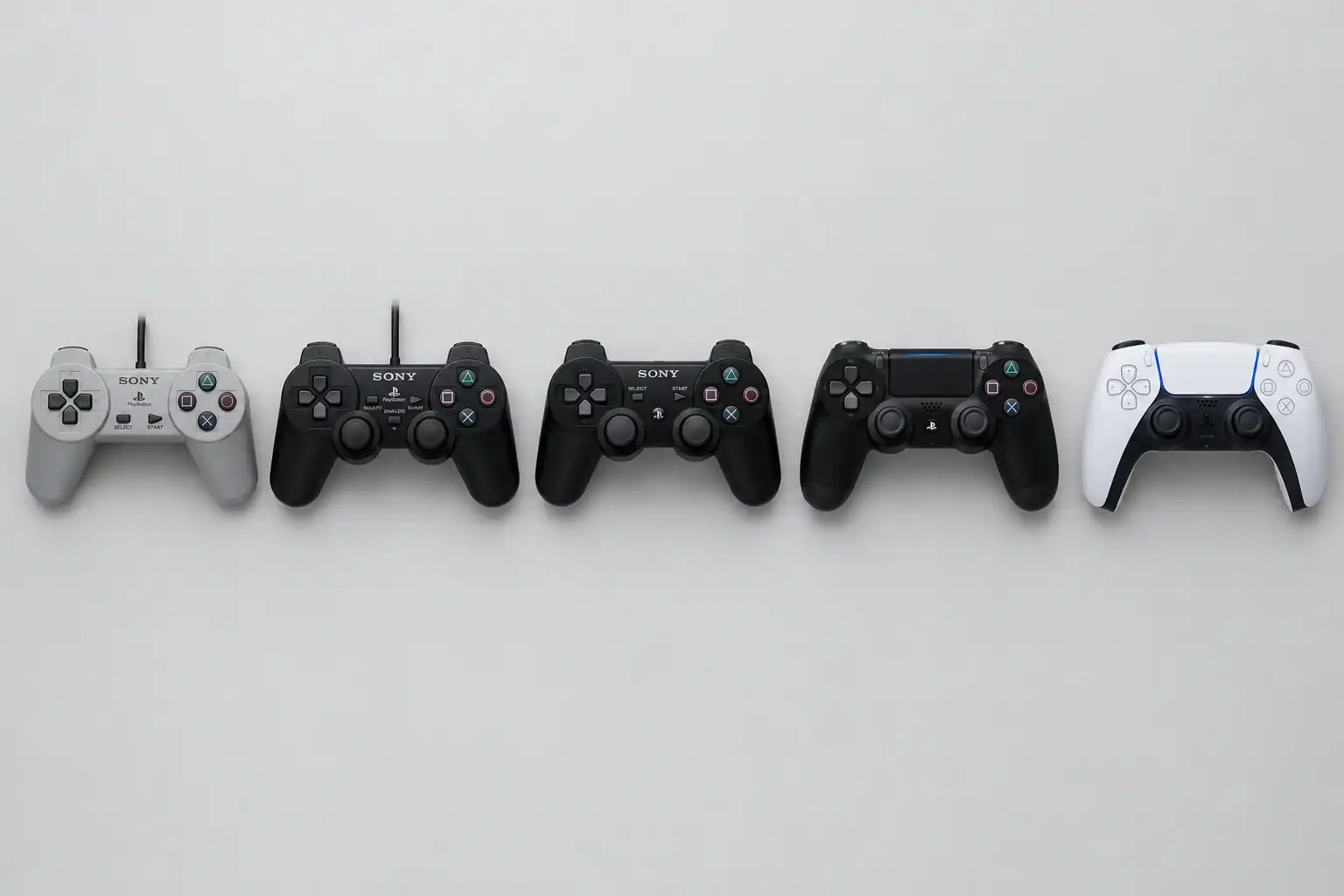
The controller also evolved significantly during this generation. The original PlayStation Control Pad established the triangle, circle, cross, and square face-button layout. Dual Analog later added twin analog sticks, and the original DualShock added vibration feedback in 1998.
That basic dual-stick controller layout would influence every subsequent PlayStation home console.
PlayStation 2 launched in Japan on March 4, 2000, North America on October 26, and Europe on November 24. Sony now reports more than 160 million PS2 consoles sold worldwide, making it one of the most commercially significant systems in gaming history.
PS2 represented several major changes at once.
Games could use DVD-ROM as well as CD-ROM, giving developers substantially more storage than the original PlayStation era. The console could also play DVD movies, making it useful as both a gaming system and home-media device.
Backward compatibility became another important feature. PS2 could play original PlayStation game discs, helping existing players carry much of their software library into the new generation.
Online multiplayer also began developing during the PS2 era, although it was not yet the deeply integrated platform-wide service that PlayStation Network would later become.
The DualShock 2 retained the familiar PlayStation controller shape while refining analog control and adding pressure-sensitive face buttons.
PS2 therefore expanded PlayStation in several directions simultaneously: larger games, home entertainment, backward compatibility, online functionality, and a rapidly growing software ecosystem.
PlayStation 3 launched in Japan on November 11, 2006, followed by North America on November 17 and Europe on March 23, 2007.
The transition from PS2 to PS3 brought PlayStation into the HD era and fundamentally changed how the console interacted with online services.
One major hardware shift was Blu-ray Disc. The format offered much more capacity than DVD, allowing developers to build increasingly large games while also turning PS3 into a Blu-ray movie player.
But the bigger long-term transformation happened online.
The PS3 era introduced PlayStation Network and PlayStation Store as central parts of the console ecosystem. Games, demos, add-ons, and other digital content could increasingly be obtained through the console instead of exclusively through physical retail.
Sony’s official history describes PS3 as a generation marked by major advances in online gaming and digital services, with PlayStation Store making downloadable games easier to access.
PlayStation Plus also began during the PS3 generation. The subscription service launched on June 29, 2010, initially offering benefits including games, discounts, and other member features on top of PlayStation Network.
Controllers changed too. PS3 initially used the wireless Sixaxis controller with motion sensing, followed by DualShock 3, which restored vibration while retaining wireless and motion-control functionality.
This made PS3 a turning point: PlayStation was no longer primarily a console plus physical games. Accounts, downloadable content, online identities, digital storefronts, patches, subscriptions, and network services were becoming fundamental parts of the experience.
PlayStation 4 first launched in North America on November 15, 2013, followed by Europe on November 29 and Japan on February 22, 2014.
By the beginning of the PS4 generation, internet connectivity and digital game distribution were no longer optional side features for much of the industry.
PS4 placed a greater emphasis on connected gaming, sharing, and streamlined digital services. Its DualShock 4 controller introduced a dedicated Share button, while the console supported gameplay broadcasting, video sharing, communities, and Share Play.
PlayStation Network became more deeply integrated into everyday console use, while PlayStation Store developed into a major distribution channel for complete games rather than primarily smaller downloads and add-ons.
PlayStation Plus also took on a larger role during this generation, including becoming a requirement for online multiplayer in many paid PS4 games.
The generation received a mid-cycle performance upgrade through PlayStation 4 Pro, expanding the idea that a console family could contain a higher-performance model without beginning an entirely new generation.
PS4’s architecture also represented a break from PS3’s unusual Cell-based hardware. This change had implications for backward compatibility: PS4 did not provide conventional native compatibility with PS3 game discs.
By the end of the PS4 era, a player’s PlayStation identity increasingly included much more than physical games: a PSN account, digital purchases, trophies, subscriptions, cloud saves, friends, downloadable content, and online multiplayer had all become normal parts of the platform.
The PlayStation 5 generation began in November 2020. Sony launched two configurations from the start: a standard PS5 with an Ultra HD Blu-ray drive and the disc-less PS5 Digital Edition.
PS5’s most significant architectural changes include its high-speed SSD storage system, newer CPU and GPU architecture, hardware-accelerated ray tracing, and support for modern display technologies.
The SSD is particularly important to the generation’s design. Previous PlayStation consoles relied primarily on optical discs and mechanical hard drives for game storage. PS5 was engineered around much faster solid-state storage (SSD), allowing developers to reduce many of the data-access limitations associated with mechanical drives.
The DualSense wireless controller marked another significant change. It replaced traditional DualShock branding and introduced dynamic haptic feedback and adaptive L2/R2 triggers capable of varying resistance in supported games.
PS5 also strengthened backward compatibility compared with PS4. The system can play the overwhelming majority of PS4 games, allowing players to bring much of their previous-generation library forward.
Sony expanded the hardware family after launch. A smaller model group appeared in 2023 with an optional detachable disc drive for the Digital Edition, while PS5 Pro later became the generation’s higher-performance model.
Looking across every PlayStation generation makes the scale of the hardware and ecosystem evolution easier to see.
| Area | PS1 | PS2 | PS3 | PS4 | PS5 |
| Era began | 1994 | 2000 | 2006 | 2013 | 2020 |
| Major physical game medium | CD-ROM | DVD-ROM | Blu-ray | Blu-ray | Ultra HD Blu-ray on disc models |
| Typical local save approach at launch | Memory card | Memory card | Internal storage | Internal HDD | Internal SSD |
| Main controller family | Original / DualShock | DualShock 2 | Sixaxis / DualShock 3 | DualShock 4 | DualSense |
| Online ecosystem | Minimal | Early game-specific online | PSN becomes central | Deep PSN integration | Expanded PSN ecosystem |
| Digital storefront | No | No modern integrated Store | PlayStation Store | Major distribution channel | Core distribution channel |
| Backward compatibility | — | PS1 support | Varied by PS3 model | Limited native legacy support | Overwhelming majority of PS4 games |
The pattern is not simply “better graphics every few years.”
Each generation changed the infrastructure surrounding games. Storage became faster, controllers gained new forms of input and feedback, networking moved from an extra feature to an essential platform service, and digital distribution grew from downloadable extras into a major way of acquiring complete games.
The evolution of PlayStation can be traced surprisingly well through its storage technologies.
The original PlayStation primarily used CD-ROM, while game saves were stored on removable memory cards.
PS2 moved major releases toward DVD-ROM, providing more capacity while maintaining support for CDs. Saves still relied heavily on memory cards.
PS3 transitioned to Blu-ray Disc and built-in hard-drive storage. This was important because games increasingly needed patches, downloadable content, installations, and digital purchases.
PS4 continued using Blu-ray while relying extensively on an internal hard drive for installed game data.
PS5 made the biggest storage-performance transition by replacing the mechanical hard drive with a custom high-speed SSD. It also supports compatible M.2 NVMe SSD expansion.
The progression can therefore be summarized as:
CD → DVD → Blu-ray → Blu-ray plus increasingly important internal storage → high-speed SSD-centered gaming
At the same time, digital distribution has made the physical medium less central for players who build primarily digital libraries.
“As PlayStation evolved from physical CD-ROMs to a completely cloud-driven digital ecosystem, managing digital ownership became essential. If you want to know how modern ownership mechanics function, read our complete guide to PlayStation digital game licenses and console sharing.”
PlayStation controllers have retained recognizable DNA while changing significantly in technology.
The original controller established the D-pad, shoulder buttons, and iconic four-symbol face-button layout.
Dual Analog added twin analog sticks in 1997. The first DualShock followed with vibration feedback in 1998.
PS2’s DualShock 2 refined that formula.
The PS3 era moved PlayStation controllers into wireless operation with Sixaxis, which also incorporated motion sensing. DualShock 3 subsequently combined motion functionality with vibration.
DualShock 4 introduced features such as the touch pad, light bar, and Share button during the PS4 generation.
PS5 then changed the branding entirely with DualSense. Haptic feedback provides more detailed tactile sensations in supported games, while adaptive triggers can dynamically alter resistance.
Despite these changes, a modern DualSense remains visibly related to the controller design established during the original PlayStation era.
Backward compatibility has never worked identically across every PlayStation generation.
PS2 offered strong compatibility with original PlayStation software, making the transition from PS1 relatively straightforward for many players.
PS3 is more complicated. Early models offered varying levels of PS2 compatibility depending on model and region, while PS1 compatibility was more broadly supported. Later hardware revisions changed the PS2 compatibility picture substantially.
PS4 did not natively play PS3 game discs. Older games instead returned through approaches such as remasters, remakes, ports, streaming, and later subscription catalogs.
PS5 provides extensive compatibility with PS4 software. The overwhelming majority of PS4 games can run on PS5, although individual titles, accessories, and features can have limitations.
This uneven history is why “backward compatible” needs context. Compatibility may refer to physical discs, digital purchases, software emulation, streaming, remastered releases, or native execution, and those methods are not interchangeable.
Early PlayStation generations were predominantly local experiences. Online functionality began appearing more meaningfully during PS2, but the PS3 era established the networked ecosystem recognizable today.
PlayStation Network connected accounts, friends, online multiplayer, trophies, digital content, and other services across the platform.
PS4 expanded that connected approach with built-in gameplay sharing and broadcasting. At launch, Sony highlighted features including online multiplayer, trophies, friends, video sharing, and live gameplay broadcasting through PSN.
On PS5, the PlayStation account remains central to digital purchases, PlayStation Plus, cloud saves, online multiplayer, friends, trophies, and other services.
This represents one of the biggest changes across PlayStation history: the console evolved from a largely standalone machine into one component of a persistent online ecosystem.
The PS3 era established PlayStation Store as a significant part of the platform. Sony’s history of PS3 specifically highlights easier access to digital games through the new Store.
Digital distribution expanded dramatically during PS4.
Instead of visiting a retailer and inserting a physical disc, players could increasingly purchase complete releases through their PlayStation accounts, download them, and maintain digital libraries.
The PS5 generation reflects how established this model has become. Sony offered a PS5 Digital Edition from launch, designed specifically around games downloaded from PlayStation Store.
Physical games have not disappeared, but digital and physical distribution now exist side by side.
That change also altered the meaning of a game collection. A modern PlayStation library can consist of physical discs, account-based digital purchases, subscription games, downloadable content, cloud saves, and cross-generation entitlements.
PlayStation Plus began during the PS3 generation in 2010 as an optional subscription layered on top of PlayStation Network. Early benefits included games, discounts, trials, and other subscriber content.
Its role expanded considerably over subsequent generations.
During the PS4 era, PlayStation Plus became tied to online multiplayer access for many paid games and continued providing member games and discounts.
The service later developed into a tiered membership structure, adding large game catalogs and additional benefits at higher tiers.
The evolution of PS Plus illustrates the broader evolution of PlayStation itself: services that did not exist during PS1 and PS2 became increasingly important components of the console ecosystem from PS3 onward.
PlayStation Portable (PSP) and PlayStation Vita (PS Vita) are major parts of PlayStation history, but they are not additional numbered generations between PS2, PS3, PS4, or PS5.
They form PlayStation’s dedicated handheld branch.
PSP first launched in Japan on December 11, 2004, followed by North America in March 2005 and Europe in September 2005. Sony positioned it as a way to take more console-like gaming and multimedia functionality into a portable format.
PS Vita arrived during the PS3 era and continued into the early PS4 period. It expanded Sony’s handheld concept with features including a touchscreen, rear touch controls, digital distribution, and integration with other PlayStation systems.
A simplified timeline therefore looks like this:
PS1 → PS2 → PS3 → PS4 → PS5 for home consoles, with PSP and PS Vita forming a parallel handheld history.
“While the transition from PS4’s massive library to the PS5 brought revolutionary SSD speeds and ray tracing, deciding whether older games justify a double-dip remains tricky. Check out our detailed breakdown of which PS4 games are actually worth upgrading to PS5 to see the titles that benefit most from modern hardware.”
Virtual reality represents another parallel branch of the PlayStation timeline.
The original PlayStation VR launched in October 2016 during the PS4 generation.
Rather than being a standalone PlayStation generation, PS VR operated as hardware connected to the PlayStation console ecosystem.
PlayStation VR2 followed on February 22, 2023, as the VR system designed around the PS5 generation.
This gives PlayStation several overlapping hardware timelines: numbered home consoles, handheld systems, VR hardware, revised console designs, and mid-generation performance models.
There is no fixed rule requiring Sony to replace a PlayStation console after a specific number of years.
Looking at the first launch of each numbered home console gives a rough pattern:
Those intervals refer to Japanese launches through PS3 and the first regional launches for PS4 and PS5, so they are best treated as a broad timeline rather than an exact lifecycle formula.
A generation also does not end the moment its successor arrives. Older consoles can remain supported, games can release across both generations, and services can continue for years.
PS4 and PS5 made that overlap especially visible through cross-generation releases, where versions of the same game were produced for both systems.
PS5’s strongest direct backward compatibility is with PS4 games. It can play the overwhelming majority of PS4 titles, subject to individual compatibility requirements.
Games from PS1, PS2, and PS3 are more complicated. A PS5 does not simply accept every physical PlayStation disc from the previous three decades.
Some older games are available on modern PlayStation hardware through specific digital releases, remasters, remakes, ports, or the Classics Catalog available with eligible PlayStation Plus memberships. The available selection and delivery method can change over time.
This distinction matters for game preservation: a game originating on an older PlayStation generation being available on PS5 is not necessarily the same as PS5 being natively backward compatible with that generation’s original discs.
For players maintaining a large legacy collection, keeping the appropriate original hardware can therefore remain relevant.
There are five main numbered PlayStation home-console generations: the original PlayStation, PlayStation 2, PlayStation 3, PlayStation 4, and PlayStation 5. PSP and PS Vita belong to PlayStation’s handheld history, while PlayStation VR and PS VR2 are VR systems associated with the PS4 and PS5 eras rather than separate numbered console generations.
The home-console sequence is PlayStation (PS1), PS2, PS3, PS4, and PS5. The original PlayStation launched in Japan in 1994, followed by PS2 in 2000, PS3 in 2006, PS4 in 2013, and PS5 in 2020. Regional launch dates differ, so individual consoles may have arrived the following year in some markets.
The first PlayStation generation began when the original PlayStation launched in Japan on December 3, 1994. It reached North America on September 9, 1995 and Europe on September 29, 1995. Sony reports that the original system went on to sell more than 102 million consoles worldwide.
PS2 introduced PlayStation players to a growing range of online multiplayer experiences, but PS3 was the generation that established modern integrated PlayStation online services through PlayStation Network and PlayStation Store. Sony describes the PS3 era as making major advances in online gaming and digital services. PlayStation Plus then launched during the PS3 generation in 2010.
Downloadable PlayStation software existed in different forms before digital distribution became dominant, but the PS3 generation established PlayStation Store and account-based digital distribution as major parts of the console ecosystem. Digital purchasing expanded further on PS4, and PS5 launched with a dedicated Digital Edition designed without a built-in disc drive.
Not in the PS1-to-PS5 numbering system. PSP and PS Vita are dedicated PlayStation handheld platforms that existed alongside Sony’s home consoles. PSP launched first in Japan in December 2004 during the PS2 era, while PS Vita followed during the PS3 era. They remain important parts of PlayStation history without replacing a numbered home-console generation.
Backward compatibility varies significantly. PS2 supported original PlayStation discs, while PS3 compatibility depended partly on hardware model. PS4 did not provide conventional native PS3 disc compatibility. PS5 provides extensive backward compatibility with PS4 software. Older PS1, PS2, and PS3 titles may still appear on modern hardware through specific ports, remasters, remakes, streaming, or catalog releases rather than universal compatibility with their original discs.